The Indian logistics industry is rapidly evolving with the adoption of advanced digital technologies. Increasing customer expectations, complex supply chains, and the demand for faster and more reliable deliveries have made the Internet of Things (IoT) and real-time visibility essential components of modern logistics operations in India..
The integration of IoT-driven systems enables logistics companies to monitor, analyze, and optimize supply chain activities in real—time, resulting in improved efficiency, transparency, and informed decision-making.
Understanding IoT in Logistics
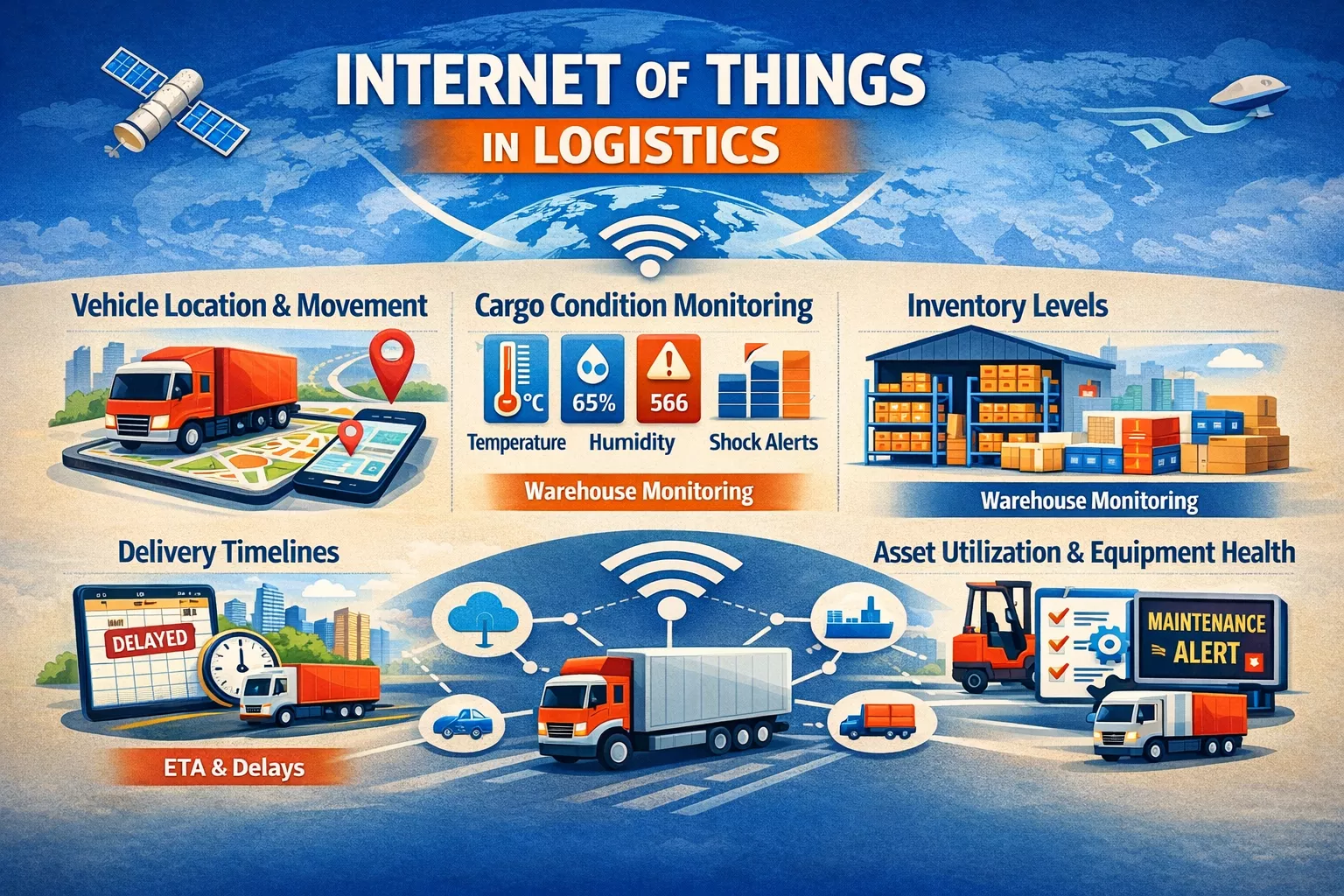
IoT in logistics refers to the use of connected devices such as GPS trackers, RFID tags, sensors, and cloud-based platforms to collect and transmit real-time data across the supply chain.
These technologies allow logistics operators to continuously track:
When combined with analytics and dashboards, IoT delivers complete end-to-end visibility across logistics operations.
Importance of Real-Time Visibility in Indian Logistics
India’s logistics ecosystem involves long-distance transportation, multi-state regulations,
diverse infrastructure, and high shipment volumes. In such a scenario, real-time visibility
plays a critical role in maintaining control and reliability.
Key Benefits of Real-Time Visibility
📍
Improved Shipment Tracking
End-to-end visibility ensures transparency across long and complex delivery routes.
⏱️
Faster Response to Delays
Real-time alerts help teams respond quickly to disruptions and route deviations.
📦
Better Inventory Accuracy
Live inventory data improves demand planning and warehouse efficiency.
💰
Reduced Operational Costs
Optimized routes and fewer delays lead to lower transportation costs.
🤝
Enhanced Customer Trust
Accurate delivery timelines and transparent tracking improve service quality.
Real-time visibility transforms logistics from a reactive process into a proactive and
data-driven operation.
Applications of IoT in Indian Logistics
Internet of Things (IoT) technologies are transforming logistics operations in India by
enabling real-time monitoring, automation, and data-driven decision-making.
📡
Fleet Tracking and Route Optimization
IoT-enabled GPS and telematics systems help monitor vehicles in real time,
optimize routes, reduce fuel consumption, and ensure timely deliveries across India.
📦
Warehouse and Inventory Management
IoT sensors and RFID technology provide real-time inventory updates,
improving stock accuracy, space utilization, and order fulfillment efficiency.
❄️
Cold Chain Monitoring
IoT continuously monitors temperature-sensitive cargo,
ensuring compliance and minimizing spoilage in pharmaceuticals and food supply chains.
🛠️
Predictive Maintenance
Connected sensors detect potential vehicle or equipment failures in advance,
reducing downtime and improving fleet reliability.
Benefits of IoT Integration in Logistics
The adoption of IoT and real-time visibility offers measurable advantages for logistics
providers and businesses by improving efficiency, control, and decision-making across
the supply chain.
⚙️
Higher Operational Efficiency
Automation and real-time data reduce manual effort and streamline logistics operations.
⏱️
Reduced Transit Delays
Live tracking and alerts enable faster responses to route disruptions and delays.
📦
Improved Inventory Accuracy
Real-time inventory monitoring minimizes stock discrepancies and planning errors.
💰
Lower Logistics Costs
Optimized routes, fuel savings, and reduced losses lead to cost efficiency.
🛡️
Better Compliance & Risk Management
Continuous monitoring ensures regulatory compliance and reduces operational risks.
🤝
Enhanced Customer Experience
Accurate ETAs and transparent tracking improve trust and service quality.
📊
Data-Driven Planning & Forecasting
Analytics-driven insights support smarter demand planning and capacity management.
These benefits make IoT a key enabler of scalable, resilient, and future-ready
logistics operations in India.
Technology-Driven Logistics Operations
Leading logistics providers such as Abhi Impact Logistics Solutions Pvt. Ltd. leverage
IoT-enabled platforms, Transport Management Systems (TMS), Control Towers, and real-time
dashboards to deliver visibility and control across supply chain networks.
Technology-led logistics operations help businesses manage complexity while ensuring
speed, reliability, and transparency.
Future of IoT and Real-Time Visibility in Indian Logistics
The future of Indian logistics lies in the integration of IoT with advanced analytics,
automation, and blockchain technology. Together, these systems will enable more secure,
intelligent, and fully digital supply chain operations.
- ✔ Secure and tamper-proof shipment data
- ✔ Automated documentation and compliance
- ✔ Predictive logistics planning
- ✔ End-to-end digital supply chains
As digital adoption increases, real-time visibility will become a standard requirement
rather than a competitive advantage.
Conclusion
The integration of IoT and real-time visibility is reshaping Indian logistics by improving
transparency, efficiency, and operational control. Logistics companies that invest in
connected technologies today are better positioned to meet growing market demands and
deliver superior supply chain performance.
IoT-powered logistics is not just a technological upgrade—it is a strategic transformation
driving the future of India’s logistics industry.